
A Practical Guide to Moroccan Caftan Measurements
Learn how to measure bust, waist, hips, shoulders, upper arms, sleeves, belt position and full length before ordering a Moroccan caftan.

Accurate measurements are the foundation of a comfortable Moroccan caftan. They influence where the shoulders sit, how the sleeves move, where a coordinating belt rests and how close the hem comes to the floor. A size label can provide a useful starting point, but it cannot describe every proportion of the person who will wear the garment.
Body measurements are not finished garment measurements
This distinction prevents many ordering mistakes. Body measurements describe you. Finished garment measurements describe the completed caftan and normally include additional room for comfort, movement and the intended silhouette. Unless a maker specifically asks for garment dimensions, provide your actual body measurements without adding extra centimetres yourself.
The amount of added room is called ease. It is not the same for every design. A softly shaped caftan, a straight caftan and a garment intended to be worn over another layer may each require a different allowance. Tell the maker how you want the piece to feel, then allow the construction method to determine the final dimensions.
Measurements work together
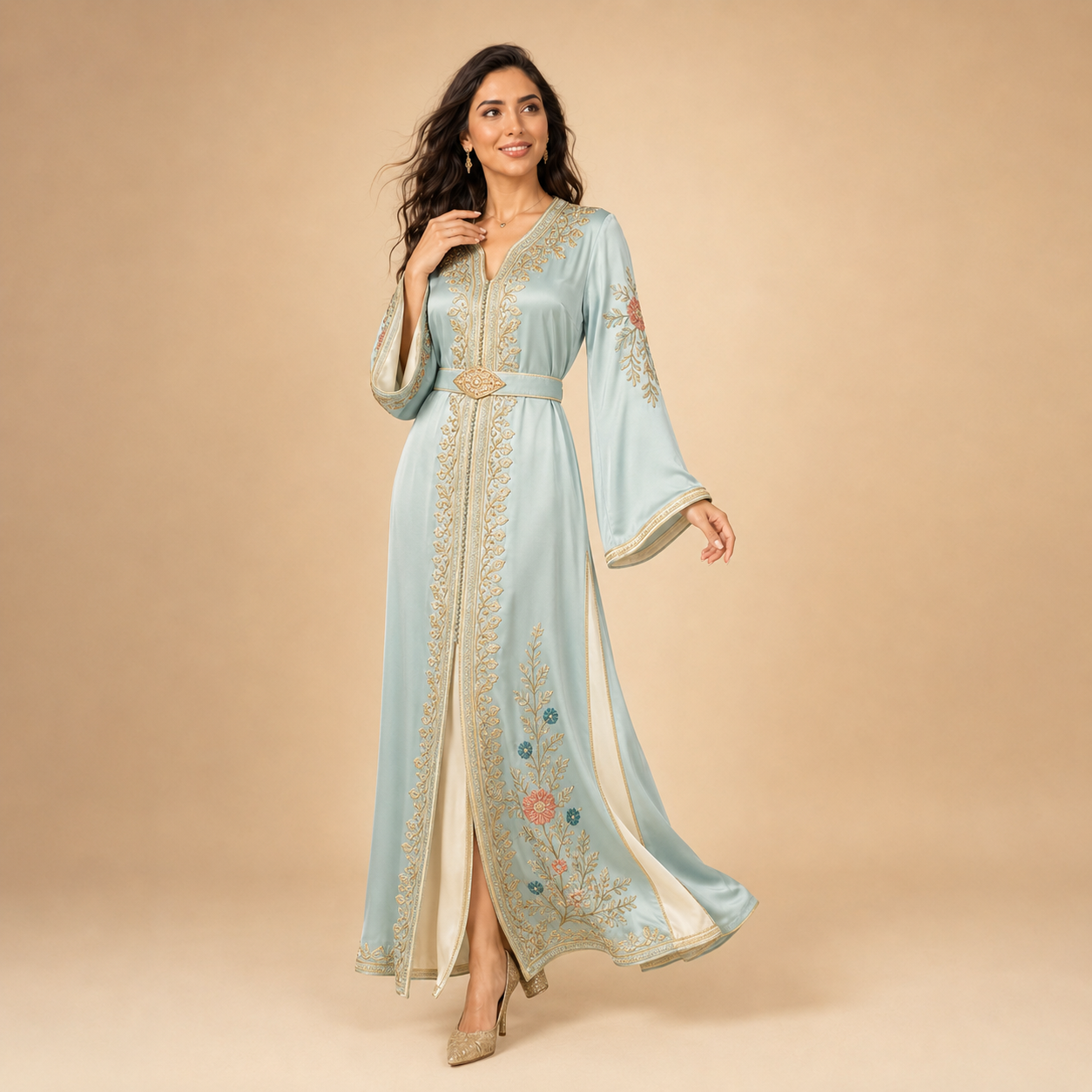
A caftan is read as one long line, but its fit depends on several connected points. Shoulder width affects sleeve placement. Bust and hip measurements influence the room through the body. Shoe height changes the appropriate garment length. Belt position affects how the front decoration aligns.
Record every value clearly in centimetres or inches and state which unit you used. Never send a bare list of numbers without labels.
Create your measurement record first
| Item | Your value | Record as |
|---|---|---|
| Bust, waist and hips | _____ | Body circumference; no added ease |
| Shoulder width | _____ | Body measurement or clearly labelled garment reference |
| Upper arm and sleeve | _____ | State the sleeve endpoint |
| Finished length | _____ | Include planned heel height |
| Belt position | _____ | Natural waist or preferred position |
| Fit preference | _____ | Closer, relaxed or layered |
Write the unit beside every value. A line such as “Bust: 94 cm” is unambiguous; a message containing only “94, 78, 102” forces the reader to guess both the order and the unit.
Prepare before you measure
Use a flexible dressmaker’s tape that lies flat against the body. A rigid building tape cannot follow curves accurately. Measure over close-fitting clothing or the undergarments you expect to wear beneath the caftan. Thick clothing adds volume and can produce a garment that feels larger than intended.
Stand naturally with your weight balanced and your breathing relaxed. Do not lift the chest, pull in the stomach or force the shoulders backward. Measurements taken in an artificial posture will not represent how the garment needs to fit during a real event.
A full-length mirror helps you check that the tape remains level, but another person is preferable for shoulders, back width, sleeves and total length. If you must measure alone, repeat each value and compare the results before sending them.
How to measure the bust
Wrap the tape around the fullest part of the bust and keep it level across the back. The tape should touch the body without compressing it. You should be able to breathe normally, and the tape should not rise toward the shoulder blades or drop at the back.
Wear the type of bra you expect to use with the caftan because its shape can change the measurement and the position of the fullest point. Do not measure over a padded coat or loose top. Record the number as your body measurement rather than increasing it for comfort.
How to find and measure the waist
The natural waist is generally the narrower area between the rib cage and hips. Bend gently to one side and note where the body folds; this can help locate it. Wrap the tape around that point while keeping it parallel to the floor.
Do not pull the tape tight enough to indent the skin. A caftan belt may eventually sit slightly above or below the natural waist according to the design, but the natural waist measurement remains an important reference. If a specific belt is included, record the circumference at the intended belt position as an additional value rather than replacing the natural waist measurement.
How to measure the hips
Stand with your feet together and place the tape around the fullest part of the hips and seat. Use a mirror to confirm that it remains level all the way around. The widest point may be lower than expected, so move the tape slightly up and down until you identify the largest comfortable circumference.
Hip room is important even when a caftan looks straight or loose. The garment must allow walking, sitting and a smooth fall below the waist. If the hip measurement belongs to a different standard size from the bust or waist, do not choose the smaller size without discussing the difference.
Shoulder width determines where the sleeves begin
Measure across the back from the outer edge of one shoulder to the outer edge of the other, following the natural curve rather than pulling the tape in a straight line through the air. The endpoints are near where the shoulder transitions into the upper arm.
Shoulder width is difficult to take accurately alone. Ask someone to help while you stand naturally with your arms relaxed. A value taken from a well-fitting non-stretch garment can be a useful comparison, but do not substitute it without telling the maker because a garment measurement already includes construction choices.
If the shoulders are too narrow, movement can feel restricted and the sleeves may pull upward. If they are unnecessarily wide, the shoulder seam may drop and alter the intended upper-body line. The correct result also depends on whether the design uses a defined or relaxed shoulder.
Upper-arm circumference and sleeve comfort
Measure around the fullest part of the upper arm with the arm relaxed at your side. Keep the tape close but not tight. If one arm is slightly larger, use the larger measurement and mention the difference when it is significant.
Upper-arm room matters even when the lower sleeve is wide. The sleeve must allow you to raise and bend the arm without pulling across the shoulder or chest. Tell the maker if you prefer a particularly loose sleeve or expect to wear another garment underneath.
How to measure sleeve length
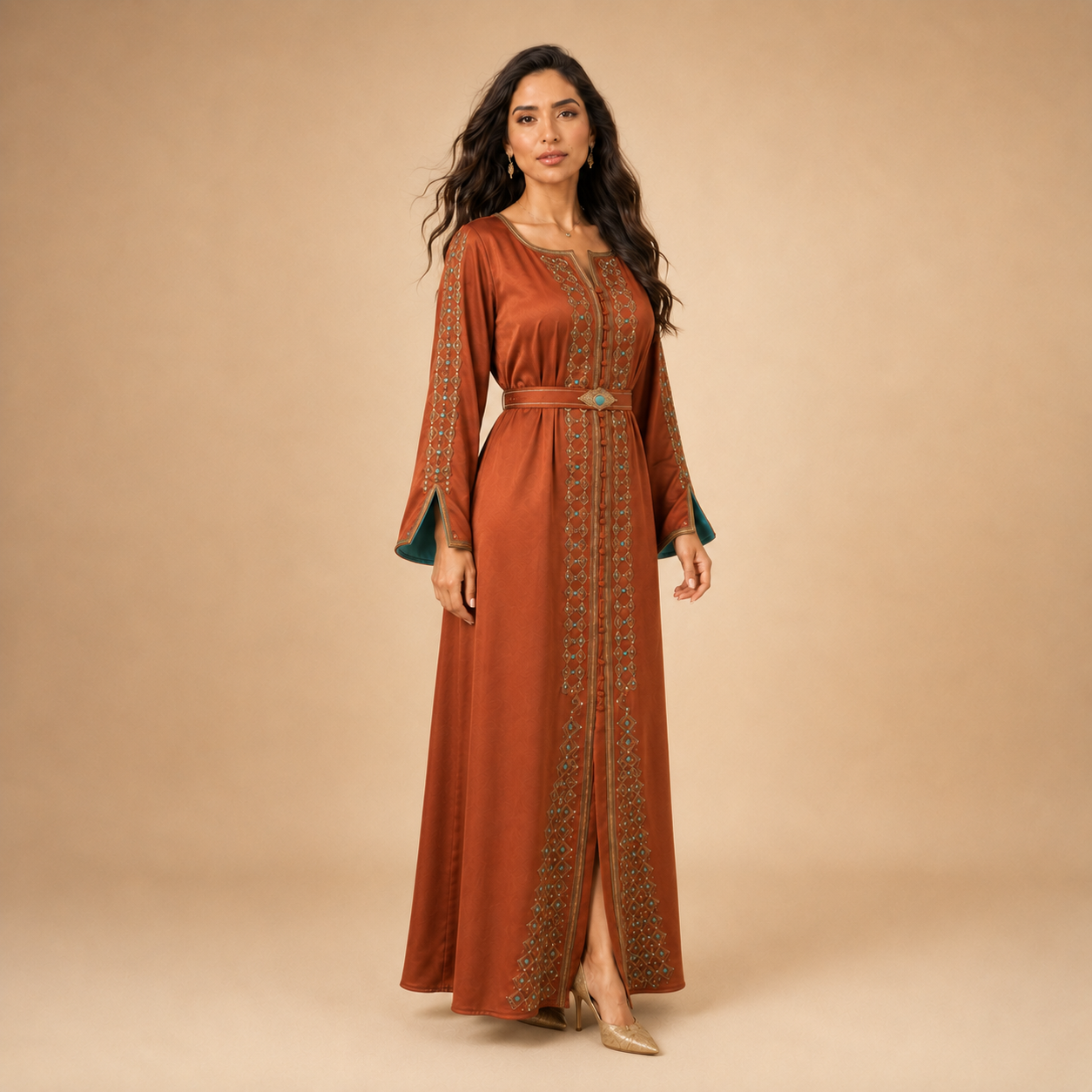
Begin at the shoulder point and follow the outside of the arm toward the wrist. Keep the arm slightly bent rather than locked straight. The exact endpoint depends on the design: a straight cuff may finish at the wrist bone, while a flared or split sleeve may be intended to extend farther.
Do not copy sleeve length from a photograph. Model height, pose and arm position can change how long the sleeve appears. Confirm whether the requested measurement should end at the wrist, hand or designed cuff edge.
Wrist, cuff and sleeve-opening measurements
A close cuff may require the wrist circumference and, depending on its closure, the circumference around the widest part of the hand. A broad open cuff does not need to fit the wrist closely, but its depth and width affect both movement and appearance.
If the design has embroidery or a shaped border at the sleeve end, changing the opening can alter the proportions of that decoration. Ask whether the motif can be resized or repositioned before requesting a substantial change.
How to determine the overall caftan length
Overall length should be measured from the high shoulder point near the base of the neck down the front of the body to the desired hem. Stand straight and allow the tape to follow the body naturally. Another person should read the endpoint while you look forward rather than bending down.
Wear shoes with the heel height planned for the occasion. Decide how much clearance you want above the floor. A floor-skimming result may look formal, but a small increase in clearance can make walking and stairs easier. If you may change into flatter shoes later, account for both pairs.
Your height is useful supporting information but does not replace garment length. Two people of the same height can have different torso and leg proportions, and they may prefer different hem positions.
Belt position and waist definition
When a caftan includes a coordinating belt, the belt measurement deserves separate attention. Measure around the point where you want the belt to sit while wearing the same underlayers planned for the event. Record both the circumference and the vertical distance from the shoulder to that position if requested.
A belt that is too tight can create pulling through the front and make sitting uncomfortable. One that is too loose may move away from the intended decorated section. Confirm how it closes and whether adjustment is possible rather than assuming every belt fits in the same way.
How much ease should a caftan have?
There is no single correct number for every caftan. Ease depends on the fabric, cut, lining, sleeve construction and intended styling. A soft unbelted shape may need different room from a caftan designed to be defined by a structured belt.
Describe the feeling you want in plain language: closer through the upper body, relaxed throughout, or roomy enough for a layer underneath. If possible, explain what you dislike about garments you already own. This gives the maker more useful information than adding an arbitrary amount to every measurement.
Standard size or custom measurements?
A standard size can be appropriate when your bust, waist and hips fall comfortably within the same range and the standard length and sleeves suit you. Compare your body measurements with the Dar Caftan size guide, remembering that the chart is a reference rather than the finished dimensions of every garment.
Custom measurements are helpful when different areas correspond to different sizes, when shoulder or upper-arm fit regularly causes difficulty, or when overall length must be adjusted. They are also valuable when decorative panels need to remain aligned with a specific belt or hem position.
Custom sizing is not the same as redesign. A request to change the neckline, sleeve shape, colour or embroidery may require separate approval and pricing. Review the made-to-order process before submitting measurements.
Common measurement mistakes
The most common errors come from pulling the tape too tightly, measuring over bulky clothing, mixing centimetres and inches, and adding ease without being asked. Other problems occur when the tape slopes across the back or when total length is taken barefoot even though heels will be worn.
Another mistake is sending measurements copied from a familiar dress without stating that they belong to a garment. Those values already include ease and may reflect a different fabric and construction. If you want to use a well-fitting garment as a reference, label every number clearly and provide your body measurements as well.
Do not rely on an old measurement record if your body, footwear preference or undergarments have changed. Retaking the essential values requires only a few minutes and is safer than assuming they remain identical.
What a clear measurement message looks like
Here is a fictional formatting example—not a recommended size and not a customer record:
Unit: centimetres
Bust: 94
Waist: 78
Hips: 102
Shoulder width: 39
Upper arm: 31
Sleeve length: 58, ending at the wrist
Preferred finished length: 145 with 5 cm heels
Fit: relaxed through the body
Underlayer: lightweight
The value of this format is not the numbers; it is the labels and context. Keep a copy and review the final order summary before preparation begins. If one number looks inconsistent, measure it again rather than silently changing it to resemble a size chart.
Measurements and decorative placement
A caftan is not only a plain shape. Neckline embroidery, central trim, cuffs, belt details and lower borders are planned in relation to the garment’s proportions. Shortening the body or sleeves may require a motif to be moved or reduced so that it does not appear crowded.
For this reason, confirm important alterations before the garment is prepared. A finished decorated border cannot always be shortened in the same way as a plain hem. Product-specific advice is more reliable than a universal alteration rule.
Frequently asked measurement questions
Should I measure tightly so the caftan looks fitted?
No. Measure the body without compression. A closer or looser silhouette should be created through the garment’s finished dimensions, not by reducing the body measurements.
Can I take all measurements by myself?
Bust, waist and hips can often be measured alone with a mirror. Shoulder width, sleeve length and overall length are more reliable when another person helps you maintain a natural posture.
Do I need to provide every possible measurement?
Not always. The required set depends on whether you are choosing a standard size or ordering custom measurements and on the construction of the design. Provide the requested values and be ready to confirm shoulders, arms, sleeves, belt position and length when relevant.
What if my measurements fall between two sizes?
Do not automatically choose the smaller size. Compare the bust, hips, shoulders and upper arms, then ask which size preserves the intended silhouette. The answer may depend on the design and available adjustment options.
Measure carefully before the caftan is prepared
Use the complete Dar Caftan size guide to review the measurement process, then explore our Moroccan caftan collection. If you are uncertain about a value, belt position or length adjustment, contact Dar Caftan before ordering.
[…] Moroccan caftan measurements guide explains how the values work together, while the general size guide provides a standard body-size […]
[…] the complete measurement tutorial for the technical steps. If the test reveals a necessary change, review the made-to-order policy […]
[…] caftan care routine. If the garment is being prepared to a specific length for travel, the measurement guide explains how planned footwear affects the […]
[…] For more detail about selecting and measuring the garment itself, see our Moroccan caftan measurement guide. […]
[…] choosing the garment itself, our occasion guide helps match formality and movement needs, while the measurement guide explains why body measurements and finished-garment dimensions are not the […]
[…] it under real light and real movement, not only in a mirror. For garment fit itself, use the Dar Caftan measurement guide and describe your planned layers when requesting custom […]