
How to Style a Moroccan Caftan Without Hiding Its Details
A practical way to choose jewellery, shoes, bags and beauty details while keeping the caftan’s neckline, belt, cuffs and embroidery visible.

A finished caftan can become visually unfinished when too many accessories are added to it. The problem is rarely that an earring, necklace or bag is unattractive. It is that each item may be asking for attention in the same part of the outfit. A decorated neckline disappears beneath a necklace, a strong belt competes with a metallic clutch, and embroidered cuffs catch against stacked bracelets.
A better starting point is to treat the caftan as the completed design and accessories as editing tools. Their job is to support what is already present. The method below begins with observation, then adds only what the outfit still needs.
Take one step back before adding anything
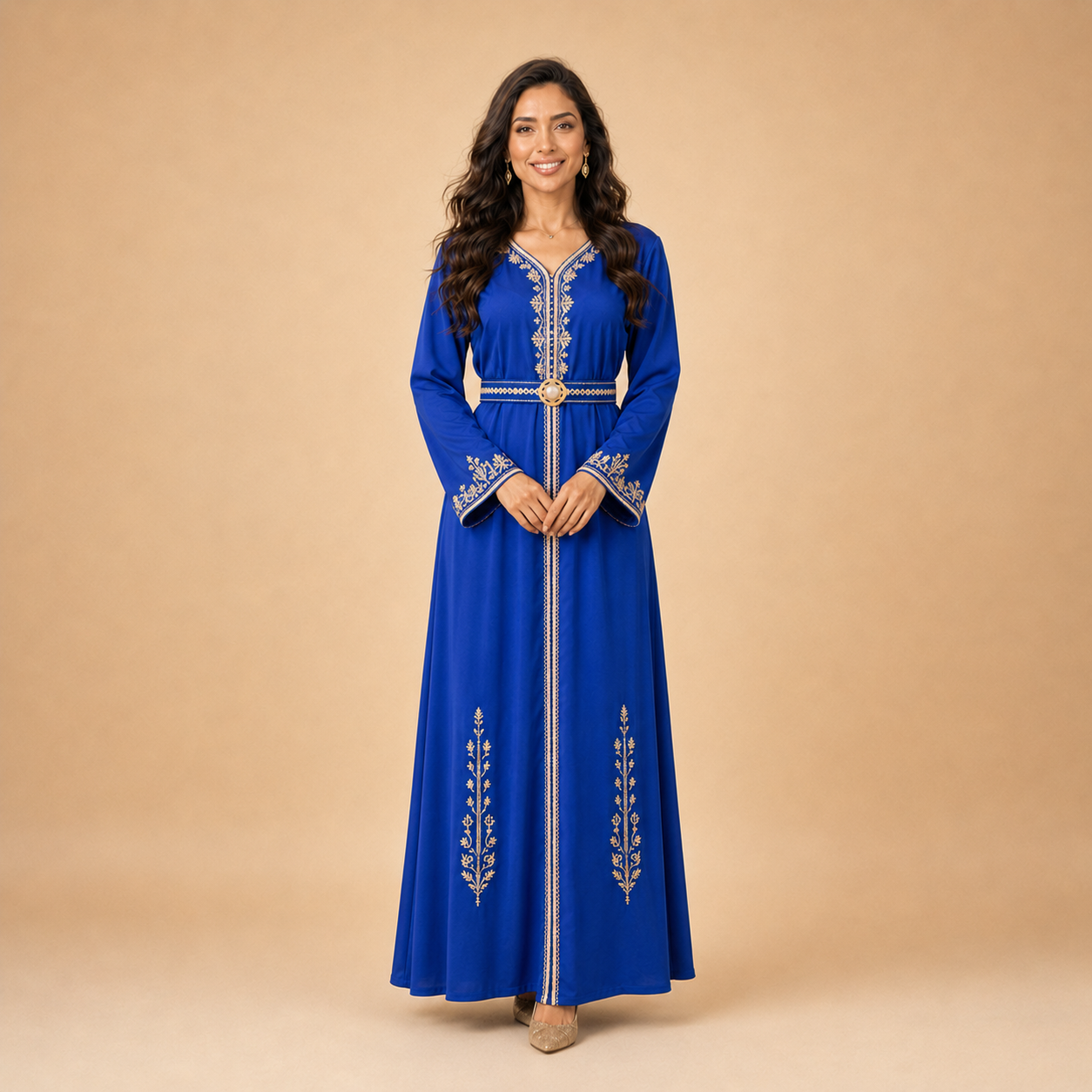
Put on the caftan with its intended belt and shoes, then stand several steps from a full-length mirror. At this distance, small workmanship becomes part of larger visual zones: face and neckline, waist, hands and cuffs, and the long line toward the hem.
Ask where your eye lands first. If the answer is the embroidered neckline, protect that area. If the belt dominates, allow it to be the main jewellery. If the fabric is plain and the trim quiet, there may be room for a stronger earring or bag.
This distant view is useful because most people at an event will not inspect the outfit from thirty centimetres away. Styling must work across a room as well as in a close photograph.
Map the four visual zones
| Zone | What may already be there | A restrained addition |
|---|---|---|
| Face and neckline | Embroidery, sfifa, decorative buttons | Earrings or a necklace—not automatically both |
| Waist | Mdamma or textile belt | A simple ring rather than another large metallic object |
| Hands and cuffs | Embroidery, beads, wide sleeves | One smooth bracelet only if it will not catch |
| Lower silhouette | Border motifs, sheen, floor length | Shoes chosen for height and movement |
The table is not a set of fashion laws. It is a way to notice competition. Two strong areas can balance each other; four unrelated focal points usually fragment the outfit.
Let the neckline choose the jewellery
A V-shaped front bordered with embroidery already frames the face. Long necklaces that cross the trim can hide the exact detail that gives the caftan its identity. In that situation, earrings are often the cleaner choice.
A quieter neckline creates more space. Try a necklace at the actual height of the opening rather than judging it in your hand. It should sit inside a plain area or follow the neckline; it should not repeatedly slip across buttons or raised threadwork.
Photograph the upper body straight on and at a slight angle. If the necklace creates a second competing V, remove it and compare. The simpler version often allows the workmanship to read more clearly.
Treat the belt as part of the jewellery
A structured mdamma changes the silhouette and reflects light across a broad horizontal area. Put it on before deciding on metallic accessories. A belt that includes gold-tone, silver-tone or stones may supply all the shine the centre of the outfit needs.
Comfort is visible. If a belt must be adjusted constantly, the wearer’s posture and movement change. Sit for several minutes, breathe normally and check whether the front trim remains aligned. Styling should not depend on enduring pressure for the length of an event.
For more detail about selecting and measuring the garment itself, see our Moroccan caftan measurement guide.
Choose earrings by distance and movement
Small drops and compact hoops remain visible without taking over the upper half of the outfit. Larger earrings can work with an unembellished neckline or an updo, but test them while turning your head. They should not catch on hair, a scarf or raised shoulder decoration.
Metal does not have to match every thread exactly. Repeat the dominant finish and allow small differences to disappear into the complete look. Antique gold embroidery beside highly polished yellow gold may feel less coherent than a quieter warm metal, even though both are called gold.
Keep the bag from becoming a second garment
Place the bag beside the full outfit, not beside the shoes alone. A smooth clutch is usually easy to pair with dense embroidery. A textured or embellished bag can add interest to a minimal caftan, but check that its pattern does not compete with the front panel.
Straps deserve practical attention. Chains and rough beading can rub against sleeves or catch threadwork. If the bag will be carried for much of the evening, test it against the actual fabric before leaving home.
Shoes decide the hem before they decide the colour
Heel height changes how a full-length caftan falls. Walk, turn, sit and use a step while wearing shoes of the planned height. A neutral shoe that gives safe clearance is more useful than a perfect colour match that leaves the hem dragging.
If you expect to change into flats later, test both pairs. A hem that works only with the highest heel can become difficult halfway through an event. The shoe is partly hidden, but its effect on movement is not.
Use hair and makeup to uncover, not cover
An updo or hair swept behind one shoulder reveals neckline embroidery and earrings. Loose hair can soften a highly structured design, but it may hide shoulder details in photographs. Try both before the event rather than deciding from a hairstyle viewed with ordinary clothes.
Makeup does not need to reproduce the fabric colour. Choose one relationship: repeat a small accent, echo the warmth or coolness of the decoration, or stay neutral. Testing in daylight and indoor light is more reliable than matching shades on a phone screen.
The remove-one-item test
- Put on the complete outfit, including every accessory you are considering.
- Take a full-length photograph and a close photograph of the neckline.
- Remove the largest optional accessory.
- Take the same photographs again.
- Keep the version in which the caftan’s construction is easier to see.
This is not minimalism for its own sake. Sometimes the stronger version includes the accessory. The point is to make the choice deliberately instead of assuming that formal dressing requires every available element.
A final rehearsal that takes ten minutes
Wear the outfit long enough to sit, reach for an object, carry the bag and walk across two different floor surfaces. Look for catching bracelets, slipping belts, sleeves that enter the plate area and shoes that change the hem. Small problems discovered at home are far easier to solve than during a celebration.
If you are still choosing between garments rather than accessories, begin with our occasion guide. Once the right caftan is selected, good styling is mostly the discipline of letting its best details remain visible.