
What Made-to-Order Means When Buying a Moroccan Caftan
Understand made-to-order Moroccan caftans, custom measurements, design changes, pricing, preparation time and what to confirm before ordering.

“Made to order” can describe several different services, so it is important to understand exactly what a seller means before buying a Moroccan caftan. It may refer to preparing an existing design after the order is confirmed, producing it to the customer’s measurements, or considering selected changes to details. These options involve different decisions, prices and preparation times.
The essential distinction
Made to order does not automatically mean that every aspect of a caftan can be redesigned. A product may be available in standard sizes, in custom measurements, or with selected adjustments that must be approved separately. The safest approach is to treat the photographed design as the starting specification and ask which changes are possible before paying.
At Dar Caftan, product descriptions distinguish standard sizing from custom measurements and ask customers to confirm additional design changes in advance. Feasibility, price and preparation time can vary according to the requested work.
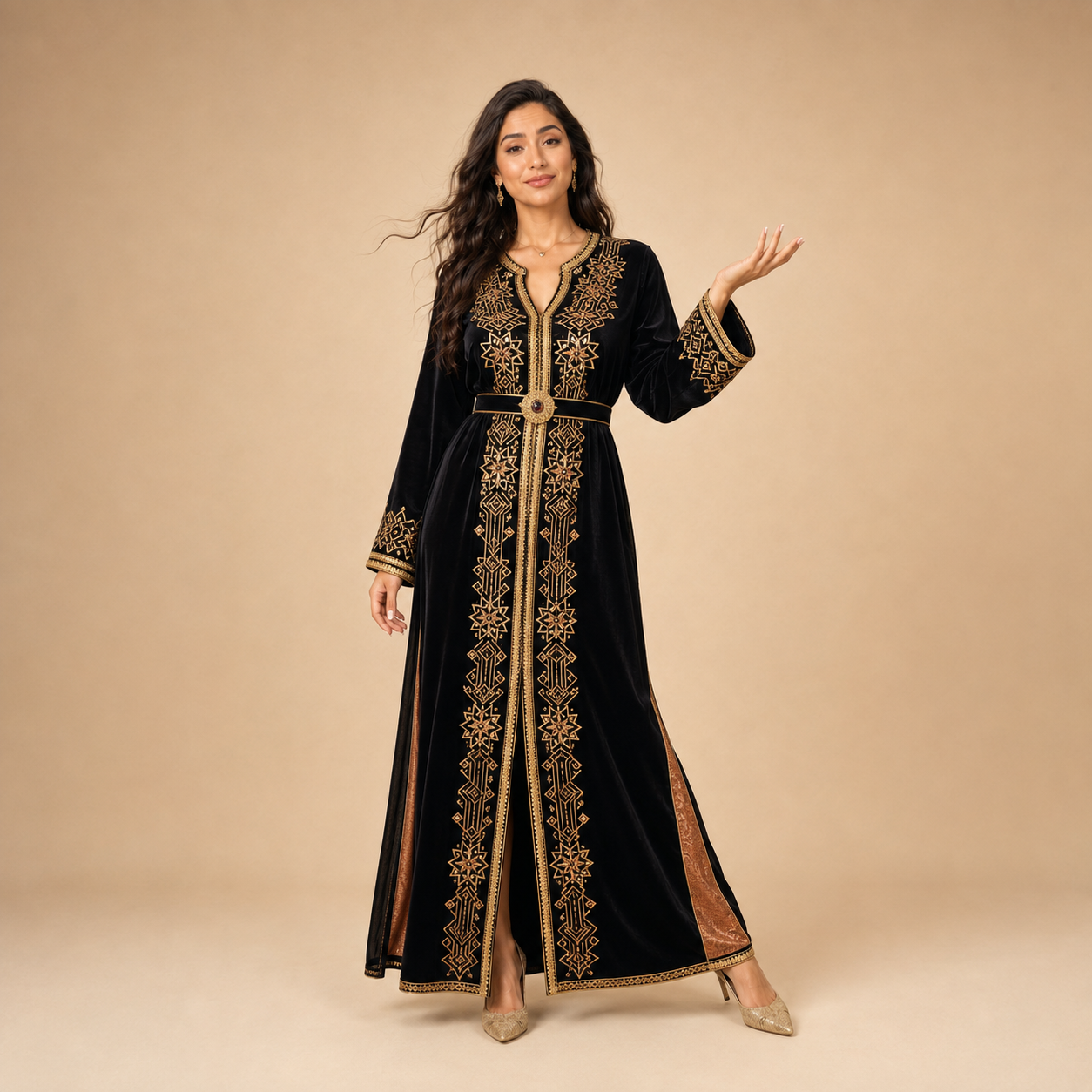
Begin from the documented design
Study the front, side and back photographs, then read the complete description. Note the neckline, belt, sleeve shape, decorative placement and colours. These are the reference points against which any requested adjustment should be discussed.
A clear request identifies what should stay unchanged as well as what you would like to alter.
Three requests that sound similar but are not
| Request | What it normally changes | What it does not include automatically |
|---|---|---|
| Standard size | The customer selects an available size for the photographed design | Individual body adjustments |
| Custom measurements | Body proportions, sleeve length and finished length after confirmation | New fabric, embroidery or construction |
| Design adjustment | A specifically approved visible detail | Every change mentioned in an informal message |
Dar Caftan listings offer standard size choices and identify when custom measurements are available. A request to change colour, neckline, sleeves, belt or decoration is assessed separately because feasibility and price depend on the selected design.
Why the product page remains important
Made-to-order service should not replace a clear product description. The page should still explain the garment shown: its main colour, decoration, neckline, sleeves, belt, back and overall silhouette. Photographs should be treated as part of that specification, while recognising that screens and lighting can change the appearance of colour.
Read every available image as a different source of information. The front shows the principal arrangement of decoration. Side views reveal volume and sleeve shape. The back confirms whether the design is plain or embellished. Video, when available, helps show movement and how reflective details react to light.
Explore the Dar Caftan Moroccan caftan collection and compare the information supplied for each design before choosing one as your starting point.
What measurements may be required?
Bust, waist and hips provide the main body reference, but a made-to-measure caftan may also require shoulder width, upper-arm circumference, sleeve length, height and preferred finished length. A coordinating belt may need its own circumference and intended vertical position.
Provide actual body measurements without adding extra room. Explain whether you prefer a closer upper body, a relaxed silhouette or enough space for a layer underneath. The maker can then determine the finished allowance according to the cut and fabric.
Our Moroccan caftan measurements guide explains how the values work together, while the general size guide provides a standard body-size reference.
Length should be discussed with footwear in mind
A full-length caftan may be intended to approach the floor, but the correct endpoint depends on footwear and how much walking the occasion requires. Measure from the high shoulder point while wearing a similar heel height to the shoes planned for the event.
If you request a shorter garment, ask how the change will affect lower borders or motifs. Decorative work placed near the hem cannot always be shortened like plain fabric. It may need to be moved, resized or reconstructed to preserve the original proportions.
Why a small design change may not be simple
A request that sounds minor can influence several connected elements. Widening a sleeve may require a larger cuff border. Raising a neckline can shorten the visible centre-front decoration. Moving the belt can change how motifs align above and below the waist.
These relationships explain why customisation requires review rather than an automatic yes. A responsible confirmation should consider whether the new version remains balanced and whether the requested materials and techniques are available.
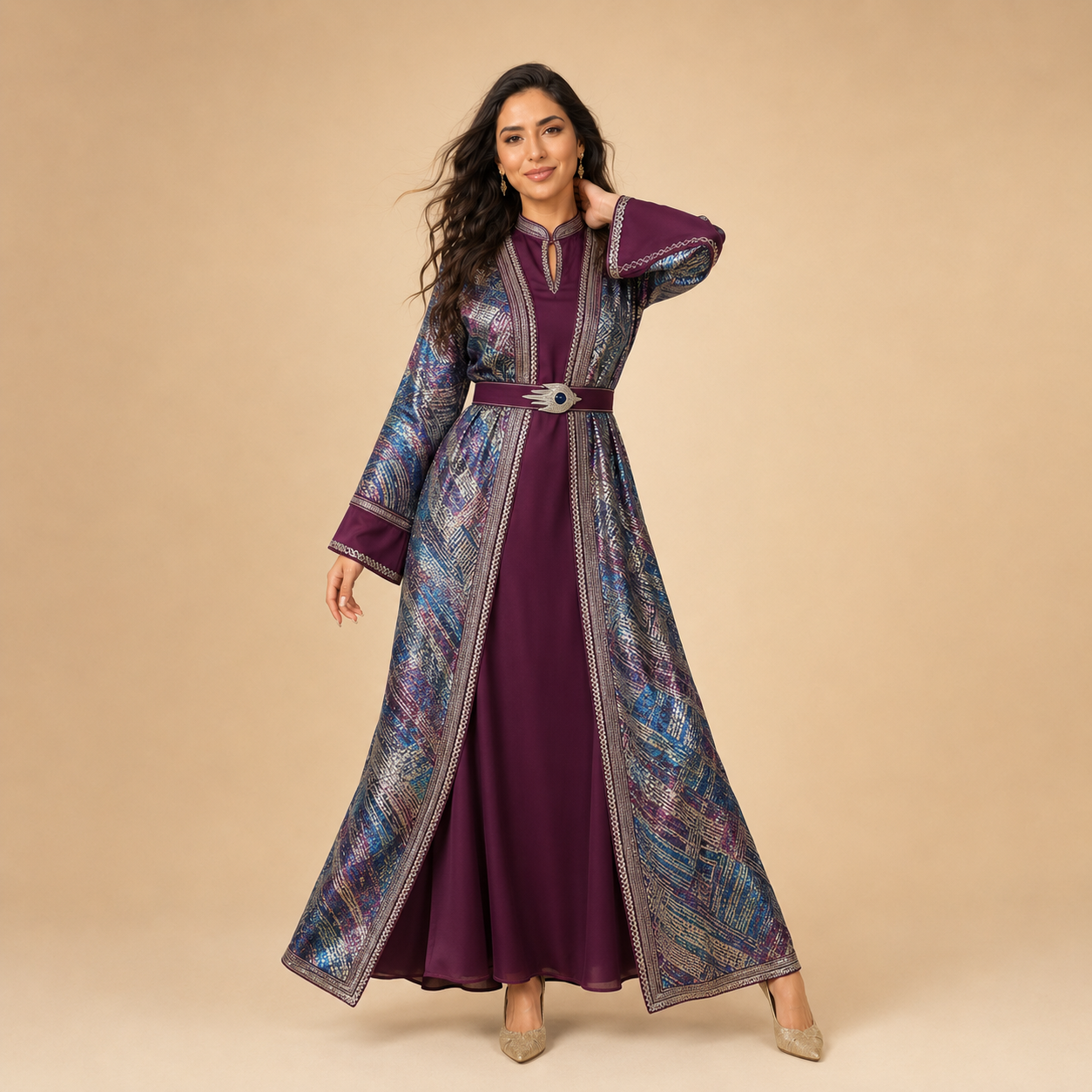
Changes to colour and decorative placement
Changing the base colour does more than replace one shade. Thread, trim, buttons, stones and belt materials must still create an intentional combination. A metallic detail that appears warm against burgundy may look different against blue, ivory or black.
Ask whether the proposed colours are based on a confirmed material sample or a screen reference. Exact colour matching cannot be guaranteed from a digital image alone because displays, lighting and fabric surfaces vary.
Removing a decorative element can also affect balance. If a cuff motif repeats the neckline or lower border, deleting only one occurrence may leave the remaining arrangement feeling incomplete. Discuss the complete pattern rather than treating every motif as an isolated addition.
Understanding price differences
Custom measurements and custom design work should be treated as separate services when they require different labour. Adapting an established pattern to body measurements is not the same as developing new decoration or changing construction.
Price may change with the complexity of the alteration, amount of handwork, materials, belt requirements and time needed to revise the design. Request a final confirmed price before ordering. Avoid assuming that a change is included because it was described in a message.
Preparation time and an event date
A made-to-order garment requires time for confirmation and preparation before delivery begins. An international order also needs an allowance for dispatch, customs processing and local carrier handling. These stages should be considered separately.
If the caftan is intended for a wedding or fixed event, provide the date and destination at the beginning of the conversation. Work backwards from the date and leave reasonable time after delivery to try on the garment. A requested date should be considered confirmed only when the seller explicitly accepts it.
Read the shipping and delivery information to understand the distinction between preparation estimates and carrier transit estimates.
The Dar Caftan confirmation sequence
- Choose the reference design. Send the exact product link so there is no uncertainty about the starting point.
- Select standard or custom sizing. For custom measurements, send labelled body values in one stated unit.
- Separate requirements from preferences. For example, a sleeve length may be essential while an alternative trim colour is optional.
- Request assessment of visible changes. Colour, neckline, sleeve construction, belt and decorative placement are not approved until they are confirmed.
- Review the order summary. Check the design, measurements, included pieces, approved adjustments, final price, destination and preparation estimate together.
Inspiration images should identify a proportion or feature, not request a copy of another maker’s design. If a detail is absent from the written confirmation, do not assume it will appear in the finished garment.
A final message worth saving
- Product name and link
- Size choice or labelled body measurements
- Preferred fit and finished length
- Approved design adjustments
- Included belt or accessories
- Final price and currency
- Delivery destination and event date, if relevant
Keeping this summary in one message gives both sides a cleaner reference than searching through a long conversation.
What made to order cannot guarantee
Accurate measurements improve the basis for preparation, but they do not make remote fitting identical to an in-person fitting. Posture, preferred ease, undergarments and measurement technique can all affect the result. Clear communication reduces uncertainty but cannot remove every variation inherent in handmade or individually prepared work.
Colour may vary from a screen, and decorative elements may show small placement differences. Customers should review the applicable terms for custom products and ask questions before the order is confirmed.
Standard sizing may still be the better choice
Custom measurements are not automatically necessary. If your body measurements sit comfortably within one standard range and the listed length and sleeves suit you, a standard size can be straightforward. It may also reduce the number of details that need confirmation.
Choose custom measurements because a proportion genuinely needs attention, not because the word “custom” appears more luxurious. The best option is the one that matches your measurements, timing and expectations.
Questions to ask before ordering
Does made to order include design changes?
Not automatically. It may refer only to preparing the photographed design after purchase or using custom measurements. Visible design changes should be approved and priced separately.
Can every caftan be shortened?
Length can often be adjusted, but lower embroidery or borders may limit how the change is made. Confirm the proposed finished length and decorative placement before preparation.
When should I send my event date?
Send it before ordering, together with the delivery destination. Preparation and delivery should be evaluated before the seller accepts the requested schedule.
Are custom products returnable?
Custom-product conditions can differ from standard-product conditions. Read the current returns and refunds policy and clarify any point that affects your decision before confirming the order.
Start with a clear design and a clear request
Review the full Dar Caftan made-to-order and customisation policy, then choose a design from our collection. For measurements, feasibility, timing or an adjustment that matters to your occasion, contact Dar Caftan before ordering.